Table of Contents
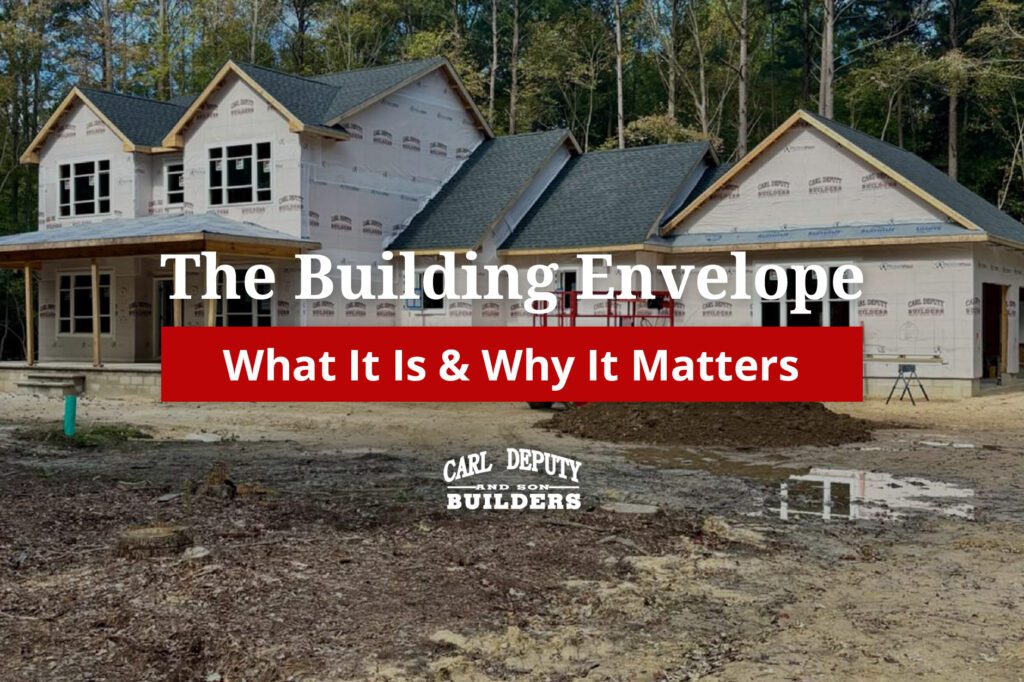
When you build a custom home in Delaware, every decision matters, from the foundation you stand on to the roof over your head. But one concept ties all of those decisions together in a way most homeowners never hear about until something goes wrong: the building envelope.
At Carl Deputy & Son Builders, we believe an informed homeowner is a better homeowner. That’s why we want to walk you through everything you need to know about the building envelope, including what it is, why it matters, how it works, and why getting it right from day one is one of the most important investments you’ll ever make in your home.
Have questions about building a home or making home renovations? Sometimes talking directly to an expert is easier than reading a post. Speak with a builder at Carl Deputy & Son Builders > (302) 284-3041
What Is a Building Envelope?
The building envelope, sometimes called the building enclosure, is the physical boundary that separates the interior conditioned space of a home from the exterior environment. In simpler terms, it’s every part of your home that stands between you and the outside world.
Think of the building envelope as your home’s first line of defense. It manages the flow of heat, air, moisture, light, and sound between the inside of your home and the outdoors. A well-designed and properly constructed building envelope keeps you warm in the winter, cool in the summer, dry year-round, and comfortable in every season, all while reducing the energy required to maintain those conditions.
The building envelope is not a single material or product. It’s a system of carefully coordinated assembly of components that must work together seamlessly. When every element is designed and installed correctly, the building envelope performs quietly in the background, requiring minimal maintenance while protecting the structure and occupants for decades. When even one element fails, the consequences can range from higher utility bills to serious structural damage.
Building Envelope vs. Building Shell: Is There a Difference?
The terms building envelope and building shell are often used interchangeably, and in everyday conversation, that’s generally fine. However, there is a meaningful distinction worth understanding, especially when you’re planning a custom home build.
- Building shell: The building shell typically refers to the structural skeleton of the home (the framing, the load-bearing walls, the roof structure, and the foundation). It’s the physical form that gives the home its shape and structural strength.
- Building envelope: The building envelope is a performance-focused concept. It refers to the complete system of components, structural and non-structural, that together control the exchange of heat, air, moisture, and light between interior and exterior environments. While the building shell is part of the building envelope, the envelope extends further to include insulation, air barriers, vapor retarders, cladding, fenestration (windows and doors), and waterproofing systems.
In other words, the shell is about structure, while the envelope is about performance. At Carl Deputy & Son Builders, we think about both simultaneously, because true quality construction requires that your home be structurally sound and thermally and hygienically high-performing.
Key Components of a Building Envelope
The building envelope is made up of many interconnected components, each with a specific role to play.
Foundation & Floor System
The foundation is both the base of your home’s structure and the lowest boundary of the building envelope. In Delaware, where soil conditions, water tables, and frost depth all influence foundation design, getting the foundation right is especially important.
A properly designed foundation envelope includes waterproofing membranes, drainage layers, and insulation on the interior or exterior of the foundation wall, or both. Slab-on-grade homes require sub-slab insulation and vapor barriers to prevent ground moisture from migrating into the living space. Basement and crawl space designs require particular attention to moisture management, since these below-grade spaces are especially vulnerable to water intrusion and humidity.
The floor system, whether it’s a concrete slab, a wood-framed floor over a crawl space, or a basement ceiling, also plays a role in the thermal and moisture performance of the envelope. Proper insulation of the floor assembly prevents heat loss through the floor and keeps surfaces comfortable underfoot.
Exterior Walls & Cladding
Exterior walls are the most visible part of the building envelope, but their job goes far beyond aesthetics. The wall assembly must manage heat transfer, resist wind-driven rain, allow moisture vapor to escape, and provide structural support all at once.
A typical high-performance wall assembly in a Delaware custom home might include interior drywall, a vapor retarder (or smart vapor control layer), structural framing with cavity insulation, a rigid foam or continuous insulation layer on the exterior, a water-resistive barrier (WRB), and a final cladding material such as fiber cement siding, brick veneer, stone, or wood.
The choice of cladding material affects not just appearance but also durability, maintenance requirements, and moisture management. At Carl Deputy & Son Builders, we help our clients choose wall systems that balance beauty, performance, and long-term value.
Roof System & Roof Deck
The roof is arguably the hardest-working component of the building envelope. It faces the full brunt of Delaware’s weather, including the summer heat, winter snow loads, hurricane-season wind and rain, and UV exposure year-round.
A well-designed roof assembly includes the structural roof deck (typically oriented strand board or plywood), an underlayment for secondary water protection, the primary roofing material (shingles, metal, tile, etc.), proper ventilation or insulation systems to manage attic temperatures and moisture, and flashing at all penetrations and transitions.
Whether a home uses a vented attic assembly (where insulation sits at the ceiling level and the attic space is ventilated to the outside) or an unvented/conditioned attic (where insulation follows the roof line and the attic is part of the conditioned space) has significant implications for energy performance, moisture management, and HVAC design. Our team will help you understand which approach makes the most sense for your Delaware home.
Windows & Glazing
Windows are often called the “weak points” of the building envelope, and for good reason. Glass conducts heat far more readily than an insulated wall, and window frames can be sources of air leakage if not properly installed and sealed.
But windows don’t have to be liabilities. Modern high-performance windows with double or triple glazing, low-emissivity (low-E) coatings, argon or krypton gas fills, and thermally broken frames can dramatically reduce heat loss while admitting natural light and passive solar heat gain.
Window placement matters just as much as window quality. South-facing windows in Delaware can capture significant passive solar heat in winter, while proper overhangs and shading prevent overheating in summer. Our design process considers the orientation of your home and the strategic placement of glazing to maximize energy performance.
Exterior Doors
Like windows, exterior doors are potential weak points in the building envelope. A poorly sealed or under-insulated door can leak heated or cooled air, allow moisture infiltration, and undermine the performance of an otherwise excellent envelope.
High-quality exterior doors should have insulated cores, weatherstripping on all four sides, properly sealed threshold systems, and thermally broken frames. The installation is just as important as the product. Even a premium door will underperform if it isn’t set plumb and level, properly shimmed, and carefully air-sealed at the rough opening.
Insulation Layers
Insulation is the component most homeowners associate with building envelope performance, and for good reason. It’s the primary tool for resisting heat flow through the envelope. But insulation is most effective when it’s part of a comprehensive system, not an afterthought.
Effective insulation strategies in Delaware homes address every part of the envelope: walls (both cavity insulation and continuous exterior insulation), attic or roof assemblies, foundation walls and slabs, and rim joists. The type of insulation matters too. Fiberglass batts, blown cellulose, spray polyurethane foam (open- and closed-cell), rigid mineral wool, and rigid foam boards all have different performance characteristics, cost profiles, and appropriate applications.
R-value, the measure of thermal resistance, is important, but R-value alone doesn’t tell the whole story. Installation quality, thermal bridging, and the integration of insulation with air barriers are equally important factors in real-world performance.
Air Barriers & Vapor Barriers
Air barriers and vapor barriers (or vapor retarders) are related but distinct components that are frequently confused with each other.
- Air barrier: An air barrier is a continuous layer, or system of layers, that resists the uncontrolled flow of air through the building envelope. Air leakage is responsible for a significant portion of energy loss in most homes, as well as moisture problems and indoor air quality issues. An effective air barrier must be continuous, structurally supported, durable, and connected at all joints and transitions.
- Vapor barrier: A vapor barrier (technically a vapor retarder in most modern building science) controls the diffusion of moisture vapor through the building envelope. Vapor control must be carefully designed based on the climate zone, the wall assembly, and the interior humidity levels of the home. In Delaware’s mixed-humid climate, getting vapor control wrong can lead to condensation and mold inside wall cavities.
Modern building science has largely moved away from the old idea of a single “vapor barrier” installed on the warm side of insulation and toward more nuanced approaches that allow assemblies to dry in multiple directions. Our team stays current with best practices in building science to ensure your home’s envelope is correctly designed.
Waterproofing & Moisture Control Membranes
Liquid water is one of the most destructive forces a building envelope must resist. Waterproofing and moisture control membranes are the specialized layers that stand between your home’s structure and bulk water intrusion.
Below-grade waterproofing (applied to foundation walls and slabs) must be able to withstand hydrostatic pressure and the movement of the foundation over time. Above-grade water-resistive barriers (applied behind cladding on exterior walls) must resist wind-driven rain while allowing the wall assembly to dry toward the exterior.
The specific products and systems used depend on the application, the exposure conditions, and the design of the overall assembly. Proper detailing at transitions where the wall meets the foundation, where the wall meets the roof, and at all penetrations is critical to achieving a continuously waterproof system.
Flashing & Sealing Systems
Flashing is the often-overlooked hero of the building envelope. Wherever the envelope changes direction, changes material, or is penetrated by a window, door, pipe, vent, or structural element, there is an opportunity for water to enter. Flashing is the material system (typically sheet metal, self-adhering membrane, or a combination) that directs water away from these vulnerable transitions.
Improper or missing flashing is one of the leading causes of building envelope failures. Leaky windows, wet walls, rotting framing, and mold growth are frequently traced back to inadequate flashing at key transitions. At Carl Deputy & Son Builders, our crews are trained to treat every flashing detail with the same care as the most visible finish work, because a poorly flashed window can cause thousands of dollars in damage long after the home is complete.
Sealants (caulks, foam, and gaskets) serve a complementary role, closing small gaps and sealing joints that flashing alone cannot address. Like flashing, sealants must be correctly specified and carefully applied to remain effective over the life of the building.
Why Is the Building Envelope Important?
A high-performing building envelope is not a luxury. It’s a foundational investment in the quality, comfort, durability, and value of your home.
Energy Efficiency & Reduced Utility Costs
The building envelope is the single greatest determinant of your home’s energy performance. When heat flows freely through poorly insulated walls, when air leaks through gaps around windows and electrical outlets, and when thermal bridges short-circuit the insulation system, your HVAC equipment has to work overtime.
A tight, well-insulated envelope reduces the heating and cooling load of your home, allowing you to install smaller, less expensive HVAC equipment while still maintaining superior comfort. Lower energy consumption translates directly to lower utility bills, with savings that compound year after year over the life of the home.
According to the U.S. Department of Energy, air leakage alone can account for 25–40% of the energy used for heating and cooling in a typical home. Addressing air leakage through a well-detailed building envelope is one of the most cost-effective investments available in new construction.
Moisture & Water Damage Prevention
Water is wood’s worst enemy, and it’s the enemy of virtually every other building material as well. Liquid water intrusion rots framing, corrodes fasteners, damages insulation, and creates the conditions for mold growth. Moisture vapor that condenses inside wall cavities can cause the same damage without a single visible leak.
A properly designed building envelope keeps liquid water out through effective waterproofing, flashing, and drainage; manages moisture vapor through appropriate vapor control; and allows assemblies to dry out when they do get wet. When the moisture management system works correctly, the structural integrity of your home is protected for generations.
Structural Integrity & Durability
The building envelope doesn’t just protect occupants. It protects the building itself. UV radiation degrades materials over time. Wind creates positive and negative pressure that stresses connections and openings. Temperature swings cause materials to expand and contract, opening gaps at joints and transitions. Moisture infiltration accelerates the deterioration of nearly every building material.
A durable envelope slows all of these deterioration mechanisms. Homes built with high-quality envelopes require less maintenance, fewer repairs, and last significantly longer than homes where the envelope was treated as an afterthought.
Indoor Air Quality & Comfort
The air inside your home is only as clean as what gets in. When a home has significant air leakage, it draws uncontrolled outside air through wall cavities, crawl spaces, attic spaces, and other areas where it can pick up dust, insulation fibers, radon, volatile organic compounds from building materials, and biological contaminants like mold spores and dust mites.
A tight building envelope, combined with a properly designed mechanical ventilation system, allows you to control where air comes from, filter it before it enters the living space, and maintain healthy indoor air quality. This is especially important in Delaware, where the humid summers create conditions favorable to mold growth if moisture isn’t properly managed.
Noise Reduction
The building envelope also serves as your home’s acoustic barrier. Dense insulation in walls and ceilings, properly sealed windows and doors, and careful attention to air sealing all contribute to reduced transmission of outdoor noise into the living space. For homes near highways, airports, or busy commercial areas, envelope design can make the difference between a peaceful, quiet home and one that requires the TV to be turned up to be heard.
Climate Control & Thermal Comfort
Thermal comfort is about more than just temperature. It’s about the temperature of the surfaces around you (mean radiant temperature), the absence of drafts and cold spots near windows and exterior walls, and the humidity level of the indoor air.
A high-performance building envelope maintains consistent surface temperatures throughout the home, eliminates cold drafts from air leakage, and keeps indoor humidity in the comfortable range year-round. The result is a home that feels comfortable at every point in every room, not just wherever the thermostat happens to be.
Long-Term Home Value
Homebuyers are increasingly sophisticated about energy performance and indoor comfort. Homes with documented high-performance envelopes (documented through lower utility bills, ENERGY STAR certifications, verified air-tightness results) command premium prices in the market and tend to sell faster than comparably priced homes with average energy performance.
Beyond market value, a durable, well-built envelope protects the physical asset of the home itself. Lower maintenance costs, fewer repairs, and longer service life for building materials all contribute to the long-term financial return on a quality building envelope investment.
How Does a Building Envelope Work?
Understanding the building envelope requires understanding the physical mechanisms it’s designed to manage.
Controlling Heat Transfer
Heat moves through the building envelope by three mechanisms: conduction (through solid materials), convection (through air movement), and radiation (through electromagnetic waves). Insulation primarily addresses conduction; air barriers address convection; and low-emissivity coatings on windows and radiant barriers in attics address radiation.
The effectiveness of the thermal control layer is measured in terms of R-value (resistance to heat flow). Higher R-values mean less heat transfer. But R-value alone is only meaningful when the insulation is installed correctly (without voids or compression), when thermal bridges are addressed, and when air leakage is controlled, because air movement can carry heat far faster than conduction through the insulation itself.
Managing Air Infiltration & Exfiltration
Air leaks through the building envelope whenever there is a pressure difference between inside and outside. Wind, stack effect (warm air rising and cold air entering at the base of the home), and HVAC systems all create pressure differences that drive air in and out of the building.
The air barrier system, which must be continuous, durable, and connected at every joint and transition, is the primary defense against uncontrolled air movement. A well-detailed air barrier dramatically reduces energy loss, moisture risk, and indoor air quality problems while making the home more comfortable.
Moisture Management & Vapor Diffusion
In addition to bulk water intrusion and air-transported moisture, water vapor can move through building materials by diffusion, driven by differences in vapor pressure between inside and outside. In winter, warm, humid interior air tends to push moisture vapor toward the cold exterior. In summer, hot, humid exterior air tends to push moisture vapor toward the cool interior.
Managing vapor diffusion requires understanding the climate zone, the indoor humidity levels, and the materials in the wall assembly. The goal is to design an assembly that allows moisture to escape in whichever direction it needs to dry without allowing condensation to form inside the assembly.
The Role of Continuous Insulation
Framing members in a typical wood-frame wall assembly conduct heat far more readily than the insulation in the cavities between them. In a 2×6 framed wall, the framing itself can represent 15-25% of the total wall area, creating “thermal bridges” that significantly reduce the effective R-value of the whole wall assembly.
Continuous insulation is the primary solution to thermal bridging. By wrapping the framing in an unbroken layer of insulation, continuous insulation dramatically improves the real-world thermal performance of the wall compared to cavity insulation alone.
Types of Building Envelopes
Different building projects call for different envelope approaches.
Ventilated vs. Non-Ventilated Envelopes
A ventilated envelope includes a designed airspace or drainage plane between the cladding and the water-resistive barrier (often called a “rainscreen” approach). This airspace allows any water that gets past the cladding to drain harmlessly away and allows the wall assembly to dry. It also reduces the direct wind-driven pressure on the WRB, making the system more forgiving of minor imperfections in installation.
A non-ventilated envelope (or face-sealed system) relies on the cladding itself to be the primary water barrier, with sealants maintaining the watertight seal. This approach requires more rigorous maintenance and is generally less forgiving of material degradation or installation errors. Modern building science strongly favors ventilated rainscreen approaches for most cladding types.
Mass Wall Envelopes
Mass wall envelopes use the thermal mass of heavy materials like brick, concrete block, stone, or adobe to moderate temperature swings by storing heat during the day and releasing it at night. Mass walls perform differently from lightweight insulated assemblies; their effectiveness depends heavily on climate, orientation, and how the mass is positioned relative to the insulation.
In Delaware’s mixed climate, mass walls are sometimes used for aesthetic reasons or for specific applications, but they typically require supplementary insulation to meet modern energy codes.
Curtain Wall Systems
Curtain wall systems are non-structural exterior wall assemblies that hang like a “curtain” from the structural frame. They are most commonly associated with commercial buildings, but the principles increasingly inform high-performance residential glazing strategies. Curtain wall systems are engineered as complete systems with integrated water management, thermal performance, and structural connections.
Insulated Concrete Form (ICF) Envelopes
Insulated Concrete Forms (ICF) are hollow foam blocks that are stacked to form wall and sometimes foundation assemblies, then filled with reinforced concrete. The resulting wall is essentially a concrete structural element sandwiched between layers of rigid foam insulation, providing excellent thermal mass, high R-values, outstanding air tightness, and superior structural strength.
ICF construction is particularly well-suited to Delaware’s hurricane-season wind exposure and can provide dramatically better thermal performance than standard wood-frame construction. Carl Deputy & Son Builders is experienced with ICF construction for homeowners looking for exceptional durability and energy performance.
Building Envelope Performance Standards & Codes
Building codes and standards set minimum performance requirements for building envelopes. Understanding these requirements helps you understand the baseline and where exceeding the minimum makes sense.
International Energy Conservation Code (IECC) Requirements
The International Energy Conservation Code (IECC) is updated on a three-year cycle and sets minimum energy performance standards for residential and commercial buildings. It includes prescriptive requirements for insulation R-values, window U-values, and air leakage limits, as well as performance-based compliance pathways.
Delaware currently references a recent edition of the IECC for its energy code requirements. The IECC divides the country into climate zones; Delaware falls in Climate Zone 4 (mixed-humid), with some areas of the northern part of the state in Zone 5. The climate zone determines the required R-values for walls, attics, foundations, and windows.
Delaware Building Code Considerations
Delaware administers its own State Building Code, which adopts and amends the International Building Code family (including the IECC) for residential construction. Local jurisdictions may have additional requirements or amendments.
As a custom home builder with deep roots in Delaware, Carl Deputy & Son Builders is thoroughly familiar with Delaware’s building code requirements and any local amendments that apply in the areas where we build. We handle code compliance as part of every project, so our clients can focus on the design and features of their home.
ENERGY STAR & Green Building Certifications
Beyond code compliance, voluntary programs like ENERGY STAR for New Homes, the National Green Building Standard (NGBS), and LEED for Homes offer frameworks for achieving building envelope performance well above the minimum code requirements.
ENERGY STAR certification, administered by the EPA, requires homes to meet rigorous thermal enclosure requirements, verified by a certified rater, including specific insulation installation quality standards, window performance requirements, and air tightness limits. ENERGY STAR-certified homes are independently verified to be more energy-efficient, more comfortable, and more durable than standard-built homes.
Blower Door Tests & Air Tightness Standards
A blower door test is the standard method for measuring the air tightness of a completed building envelope. A calibrated fan is temporarily mounted in an exterior door opening, and the pressure inside the home is depressurized to a standard level. The amount of airflow required to maintain that pressure difference is a measure of the home’s air leakage.
Results are typically expressed in ACH50 (air changes per hour at 50 Pascals of pressure difference) or CFM50 (cubic feet per minute at 50 Pascals). The current Delaware energy code requires a maximum of 3 ACH50 for new construction. ENERGY STAR requires less than 3 ACH50, while high-performance programs like Passive House push the target below 0.6 ACH50.
At Carl Deputy & Son Builders, we perform blower door testing on our homes as part of our commitment to quality and as verification that the building envelope we designed and built is performing as intended.
Common Building Envelope Problems & How to Avoid Them
Understanding common building envelope failures helps you ask the right questions and make better decisions during the planning and construction process.
Air Leakage & Drafts
Air leakage is the most common building envelope problem in residential construction. It results from gaps at electrical boxes, plumbing penetrations, top and bottom plates, window and door rough openings, attic hatches, recessed light fixtures, and countless other locations where the air barrier is interrupted.
The solution is a systematic approach to air sealing during construction, sealing every penetration and transition as each layer of the building envelope is installed, rather than trying to add air sealing at the end. Our crews follow detailed air sealing protocols on every home, and we verify results with blower door testing.
Thermal Bridging
Thermal bridging occurs wherever heat can travel through a highly conductive material that bypasses the insulation layer. Steel framing, wood framing at corners and headers, structural connections between interior and exterior elements, and cantilevered floor systems are all common thermal bridges.
The solution involves both design and detailing: designing wall assemblies that include continuous insulation to break thermal bridges, carefully detailing structural connections to minimize direct conduction, and reviewing the building envelope design for thermal bridges before construction begins.
Moisture Intrusion & Mold
Moisture intrusion can come from bulk water (rain, groundwater) or from moisture vapor, and both can cause mold growth, material deterioration, and structural damage. The causes range from missing or improperly installed flashing to vapor control strategies that don’t match the climate to excessive interior humidity without adequate ventilation.
Prevention requires a comprehensive approach: proper waterproofing and flashing for bulk water; appropriate vapor control for diffusion; an airtight envelope combined with mechanical ventilation to manage interior humidity; and materials that are resistant to moisture and can tolerate occasional wetting without deteriorating.
Poor Window & Door Sealing
Windows and doors are among the most failure-prone components of the building envelope. Common problems include improper head flashing, missing or deteriorated sill pan flashing, inadequate air sealing at the rough opening, and compressed or missing weatherstripping.
Quality window and door installation requires attention to the full sequence of details: rough opening preparation, sill pan flashing, installation of the unit with proper shimming and leveling, integration of the window flanges with the WRB, head flashing installation, interior air sealing at the rough opening frame, and final weatherstripping inspection.
Improper Flashing Installation
Missing, improperly lapped, or incorrectly sequenced flashing is one of the most common causes of building envelope failures. Water management at transitions, where the roof meets the wall, where the wall meets the foundation, at window and door openings, and at penetrations, requires careful attention to the sequence of installation and the proper integration of materials.
Our approach to flashing is to treat every transition as a critical detail that deserves the same care as the most visible finish work, because the consequences of a flashing failure are far more expensive than the time it takes to do it right.
Inadequate Insulation Thickness or Placement
Insulation that is compressed, has voids, is missing at critical locations (rim joists, attic hatch, knee walls), or is simply below the required R-value for the climate zone is a pervasive problem in residential construction. Even well-intentioned insulation installation can be undermined by poor quality control.
At Carl Deputy & Son Builders, we conduct thorough insulation inspections before any insulation is covered by drywall or other finishes, and we verify that insulation is properly installed throughout the entire building envelope, not just in the easily visible locations.
Building Envelope Considerations for Custom Homes in Delaware
Delaware’s geography and climate create a specific set of challenges and opportunities for building envelope design. Located in IECC Climate Zone 4A (mixed-humid), Delaware experiences hot, humid summers and cold winters – a combination that demands a building envelope capable of performing well in two very different conditions.
Summer performance requires the envelope to reflect solar heat gain, prevent humid outdoor air from infiltrating the home and condensing on cool interior surfaces, and resist the inward diffusion of moisture vapor toward the air-conditioned interior.
Winter performance requires the envelope to retain the warmth of the heated interior, prevent the outward diffusion of moisture vapor from the heated interior from condensing inside the wall cavity, and resist air leakage driven by the stack effect.
Delaware’s coastal and near-coastal locations add wind and salt air exposure to these concerns. Cladding materials, window frames, and fasteners must be selected for corrosion resistance as well as thermal performance.
Delaware’s soil conditions, including sandy coastal soils and the clay-heavy soils of some inland areas, influence foundation design and the waterproofing strategies required to keep basements and crawl spaces dry.
Hurricane season wind exposure in Delaware is a real factor in envelope design. Roof systems, wall-to-roof connections, window and door selections, and the overall structural integrity of the envelope all need to account for high wind events.
Finally, Delaware’s relatively mild shoulder seasons create opportunities for passive strategies like strategic window placement for cross-ventilation, solar orientation, and thermal mass that can reduce HVAC loads and improve year-round comfort.
Building a custom home in Delaware means navigating all of these considerations simultaneously. At Carl Deputy & Son Builders, this is exactly what we do. We design and build homes whose envelopes are specifically tailored to Delaware’s climate, soil conditions, wind exposure, and the performance goals of each individual client.
Build Your Delaware Home Right with Carl Deputy & Son Builders
The building envelope is where the quality of a home is truly decided. It’s the system that will determine your utility bills, your comfort, your indoor air quality, the durability of your home’s structure, and ultimately the long-term value of your investment.
At Carl Deputy & Son Builders, we’ve been building custom homes in Delaware with the care, craftsmanship, and attention to detail that a high-performance building envelope demands. We don’t treat the envelope as an afterthought or a checklist item. We treat it as the foundation of everything else we do. If you’re ready to build a custom home in Delaware and you want it built right, we’d love to talk with you. Contact Carl Deputy & Son Builders today to start the conversation about your new home.