Table of Contents
If you bought your house in your 20s, 30s, or even your 40s, accessibility might not have been a major consideration. As you get older or deal with health issues, however, you might start to think about things like having to go up and down stairs to do laundry or use the bathroom. At this point, you might start to consider whether it will be possible to stay in your home as you get older.
Aging in place home design incorporates aspects of universal design and accessible design to transform a home into a place where its owners can live independently, even with age-related health challenges. By doing things like installing non-slip flooring and sturdy handrails for stairs, you may be able to avoid or put off going into senior living. Our checklist can help guide you as you decide how to adapt your home so that you can age in place.
At Carl Deputy & Son Builders, we work with homeowners throughout Kent and Sussex Counties in Delaware to build and renovate gorgeous homes. Whether you want to remodel your existing home to make it more accessible or build a new custom or semi-custom home to age in place, we can help. Reach out today to schedule a consultation with a member of our design and construction team.
Have questions about building a home or making home renovations? Sometimes talking directly to an expert is easier than reading a post. Speak with a builder at Carl Deputy & Son Builders > (302) 284-3041
What Is Aging in Place?
Aging in place is a home design principle that allows older people to stay at home as they get older, rather than moving to a nursing home or assisted living. Just 1% of homes in the United States are geared towards aging in place, yet more than 75% of older Americans want to remain in their own homes for as long as possible.
Aging in place design offers a way to make home modifications to allow you to remain in your home. It takes into consideration the health issues that many of us will face as we get older, such as:
- Balance issues
- Reduced mobility
- Loss of strength and endurance
- Reduced vision and hearing
- Decreased mental capabilities
These issues can affect your ability to go about your daily life. It may make it harder to do things like cooking, doing laundry, bathing, and even just navigating your home. These challenges can make it far more difficult for an older person to live independently.
Aging in place design anticipates these health problems and other limitations. By adapting your home to account for these eventualities, you may be able to stay in your home longer or for the rest of your life. Because long-term care is so expensive, it may also be a financially smart move to modify your house so that you can remain in it.
When Aging in Place Makes Sense
Of course, aging in place isn’t possible for everyone. While there are a lot of benefits to these principles, there are situations where it just doesn’t make sense to try to modify your home to age in place. Aging in place design works best if:
- Your home is accessible or can be made accessible with modifications.
- You are in relatively good health and are comfortable living on your own.
- You have access to transportation.
- You have a strong support system, including family, friends, and medical professionals.
- You value independence.
If your situation is different, you may want to consider alternatives. For example, instead of renovating your home, you might choose to build a new custom or semi-custom home that is designed with accessibility in mind. Our team of design experts can work with you to explore options for renovating your existing home or building a new home to meet your aging in place needs.
A Checklist for Aging in Place Home Design
If you want to explore aging in place home design, you might be feeling a bit overwhelmed at the sheer amount of work that needs to be done. The first step is to assess your current situation and create a long-term plan for the future. The goal here is to do this gradually so that when you need it, your home will be more accessible to you.
This assessment can also be incredibly useful when it comes to deciding whether it is possible to age in place in your current home. For example, if you have an older, two-story home with the only bathroom on the second floor and the laundry in the basement, it might be difficult to modify your house to meet your needs. An addition might be necessary to add a first-floor primary suite and bathroom, for example.
Our aging in place checklist is a great place to start. It can help guide you as you make decisions about how to renovate your home for the future. It can also help you decide if making these modifications to your home is feasible as a practical or financial matter.
The following guide has ideas that you can implement as you work on your home to make it possible to age in place:
Exterior
- Stairs are slip-resistant.
- Install a ramp if necessary.
- Handrails are sturdy, easy-to-reach, graspable, and slip-resistant.
- Exterior doorways are wide enough for walkers or wheelchairs.
- There is ample outdoor lighting.
- Driveways and walkways are in good repair.
- Consider a covered entryway for protection from the elements.
- Keep exterior stairs in good repair.
- The house number is clearly visible from the street for first responders.
- The doorbell is in an accessible location.
- There is a surface where packages can be placed while opening the door.
- All exterior doors have secure, easy-to-use locks.
- Create at least one no-step entry into the home.
- Consider low-maintenance landscaping.
- Install automatic exterior lights that turn on in low light.
Interior Safety
- Thermostats are easy to locate with easy-to-read settings.
- Light switches are located near each hallway entrance.
- All light switches are standard, rocker, or touch switches.
- There are smoke and carbon monoxide detectors.
- Windows and safety locks are easy to operate.
- Electrical receptacles are easy to reach.
- Window drapes, shades, and cords are easy to reach and to operate.
- A laundry facility should be located on the primary living level for multi-story homes.
- The main living area should be on a single story, including a full bathroom.
- There should be a 5-foot by 5-foot clear turn space in all main rooms.
- Consider a residential elevator or lift for multi-level homes.
- All closets should include lighting.
- Put a bench in the entry for a place to sit on when removing shoes.
- Purchase bed risers or an adjustable bed to make it easier to get in and out of bed.
- Use motion-activated night-lights, especially in bedrooms and bathrooms.
- Consider installing voice-activated smart lighting.
- Swap doorknobs for lever handles.
- Widen doors to accommodate wheelchairs or walkers.
- Install sturdy railings on all stairs (exterior and interior).
Flooring
- Install carpeting over hard surfaces like concrete or ceramic floors to reduce the risk of fall injuries.
- Carpeting should be a low-density pile with a firm pad.
- All surfaces should be smooth, slip-resistant, and non-glare.
- There should not be steps between rooms on a single level of the house.
- Any rugs or runners should be secure and non-slip, with secured edges.
- There should be a color and texture contrast to indicate flooring changes.
Kitchen
- Adjust the location of major appliances to make them easier to reach.
- The microwave is on the wall or on the counter, with easy-to-read settings.
- The oven is mounted on the wall or has a side-swing opening, with easy-to-turn knobs or buttons.
- The washing machine and dryer are raised, with easy-to-turn knobs and a front-loading washer.
- Purchase a refrigerator with handles that are accessible from a wheelchair or a walker.
- The dishwasher is raised and has push-button controls or easy-to turn knobs.
- The stove is electric with a level cooktop, front controls, and a light to indicate when the surface is hot.
- There is enough space around counters and islands to allow space for turns.
- Cabinets are easy to reach with easy to use pulls or knobs.
- Add slide-out drawers or trays to existing cabinets for better access.
- Counters are set at a comfortable height.
- There is appropriate lighting.
- Any kitchen rugs have slip-resistant backing.
Bathroom
- Counter heights are at a safe level.
- Rugs have slip-resistant backing.
- There is a door to access the tub or shower.
- A fold-down seat, shower chair, or bench is installed in the shower.
- The shower is equipped with an adjustable showerhead with a 6-foot hose
- The shower has recessed, waterproof, automatic lights.
- The tub should be low for easy entry and exit.
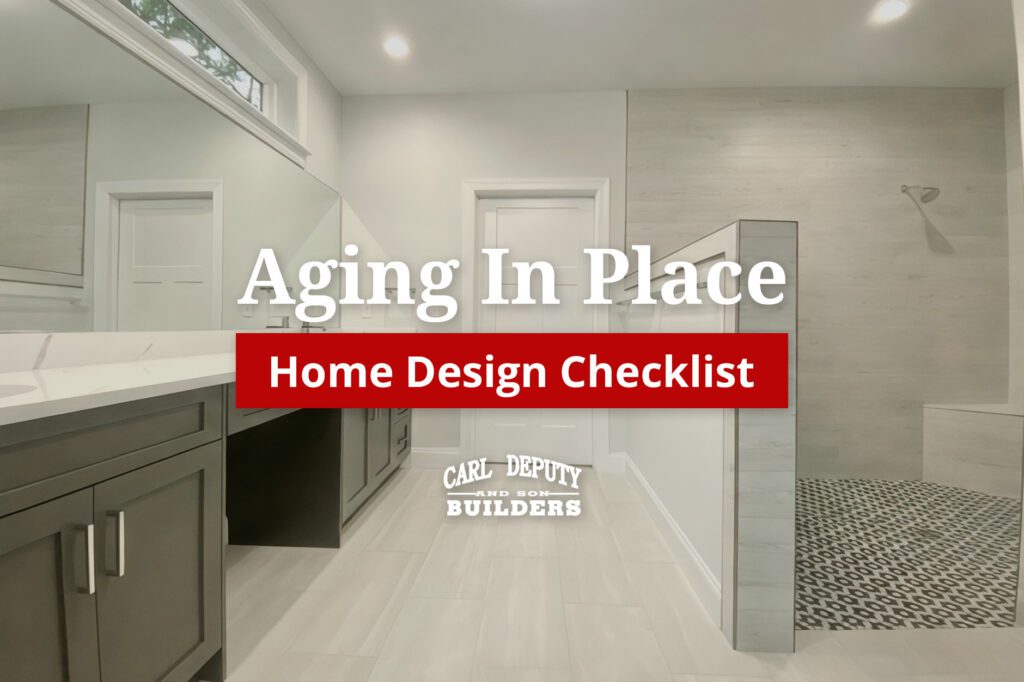
- A stand-up shower should be curbless and wide (zero entry or walk-in shower).
- All flooring should be slip-resistant.
- Windows should be easy to reach and to open and close.
- Grab bars of appropriate height should be placed in the tub/shower and toilet areas.
- For wheelchair accessibility, a removable base cabinet should be installed on the vanity.
- The toilet should be raised or comfort height.
- Faucet handles should be levers instead of knobs or pedal-controlled.
- Cabinets should be easy-to-reach.
- At least one bathroom should be on the main level and wheelchair-accessible.
- An emergency call button or intercom should be located in the bathroom in an easy-to-reach area.
Many of these modifications are relatively simple and inexpensive to implement. For example, you can swap out doorknobs in your house for lever-style handles, which will make doors easier to open if you lose mobility or strength in your hands. Similarly, buying night lights or adding slip-resistant strips to your tub won’t cost much or take much time.
Of course, other ideas on this list require a much bigger investment of both time and money. Widening doorways, installing a ramp, adding a first-floor bathroom, or buying new kitchen appliances can all be costly. Our design team can work with you to help you understand your options and what is and isn’t possible with your existing space.
Aging in Place Home Construction and Renovation Services in Delaware
Aging in place home design principles range from simple fixes to more extensive renovations and additions. While incorporating these ideas into your house can be pricey, it can also allow you to stay in your home and live independently for far longer than you otherwise may be able to do. If your home can’t be easily renovated, you may also consider building a new, accessible home.
If you are considering renovating your current home or building a new house, Carl Deputy & Son Builders can work with you to plan and design a house that lets you age in place for as long as possible. We offer a range of construction services to homeowners throughout Sussex and Kent Counties, including home builds and renovations that incorporate universal design principles to allow you to remain in your home. To learn more about or to schedule a consultation with a member of our team, give us a call at 302-284-3041 or fill out our online contact form.